
Solving problems through automated mobility services will surely contribute to society.

INTRODUCTION

Although there are regional differences, "declining birthrate & aging population" and the "driver shortage" are crises that are certain to arrive in the near future. Due to the fragmentation of the public transportation network, many people have been severely deprived of their freedom of movement, and it is predicted that it will become difficult to maintain their conventional way of life in the future. The problems are beginning to become more pronounced from depopulated rural areas. One of the ways to solve this problem is the self-driving transportation service. Each municipality conducts demonstration experiments with various partners, such as companies that handle transportation (movement of people) and logistics (movement of goods), with the aim of social implementation of autonomous driving transportation services. Nippon Koei provides consulting services to maintain a prosperous and harmonious society, looking beyond the future where autonomous driving becomes a social infrastructure.
PROFILE

  • Transportation Policy & Planning Division, Transportation Operations, Consulting Operations Headquarters, Nippon Koei Co., Ltd.

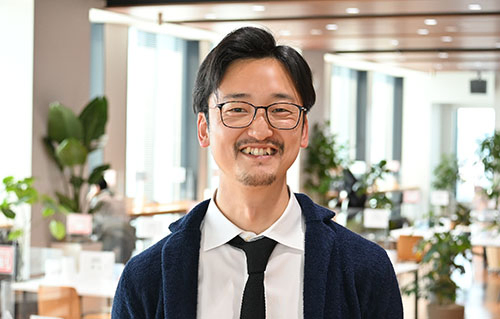
    Takayasu Osara

    Joined the company in 2010. Assigned to the Transportation and Urban Planning Department. He has been working on various issues using cutting-edge technologies. He has been engaged in a project aiming at the implementation of automated driving since 2018, utilizing his experience as an expert in transportation planning and various plans. Currently, he is deeply involved in the automated driving demonstration projects in Odaiba area in Koto-ku, Tokyo, and Tochigi Prefecture, aiming for social implementation from various demonstration experiments and planning.
  • Team members

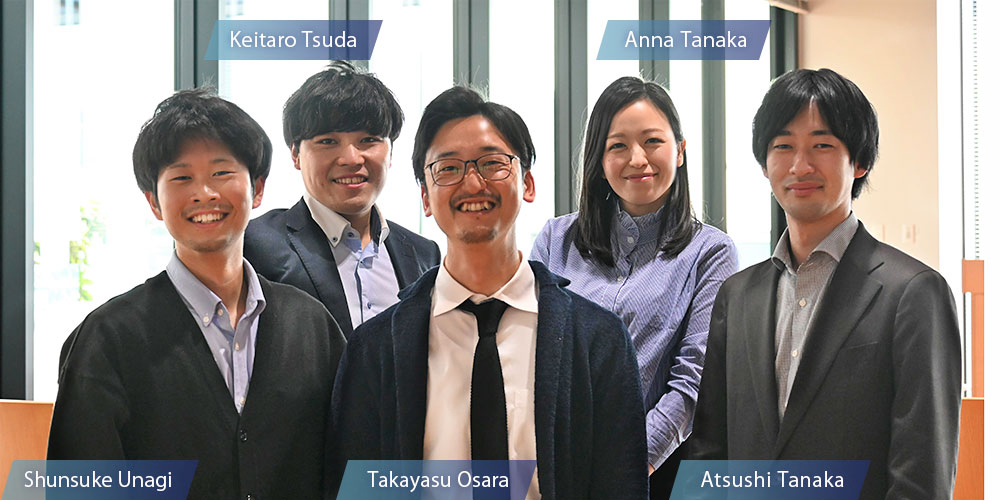
    Anna Tanaka (joined in 2022), Atsushi Tanaka (joined in 2018), Ken Yasuike (joined in 2019), Keitaro Tsuda (joined in 2021), and Shunsuke Unagi (joined in 2022) are involved as core members in the study work related to automated mobility services and work as a Osara-team.
    (Photo from left: Keitaro Tsuda, Shunsuke Unagi, Anna Tanaka, Atsushi Tanaka)

  • *The department name, job title, and interview content were at the time of the interview.

STORY

Each municipality has different needs for automated mobility services. The common point is that it will be difficult to maintain the current lifestyle if we do not hurry to realize it.

―In recent years, demonstration experiments of automated driving have been conducted in various parts of Japan. At the beginning of 2023, when this article was written, Nippon Koei conducted a demonstration experiment in the waterfront subcenter of Koto-ku , Tokyo, and the achievements were reported in various media. Until recently, automated driving was considered a dream technology, but now we are at the stage where social implementation is imminent. Nippon Koei is participating in a plan to implement automated driving in several years in Tokyo and Tochigi prefectures. We asked Mr. Osara and his team members of the Transportation Planning Department about the progress of each project and the future of Japan's automated driving technology.
Osara
Demonstration tests are being conducted in various places because the government has declared that it aims to realize automated transportation services in 50 locations by the end of fiscal 2025. In response to this trend, each local government has created a roadmap for implementation and has accumulated demonstration experiments. Typical examples of Nippon Koei's involvement are Tokyo Metropolitan Government and Tochigi prefecture. These two projects are very contrasting. Tokyo Metropolitan Government is required to succeed in a difficult project with a lot of traffic and pedestrians, aiming for the social implementation of high-quality automated driving. On the other hand, in Tochigi Prefecture, the project implementation was motivated by the declining quality of life of residents. This is because it is no longer possible to maintain public transportation at the previous level due to the return of driver’s licenses and a decrease in the number of drivers with the aging population. The main feature is that not only municipality but also bus operators and citizens have a high sense of crisis.
Tanaka(Anna)
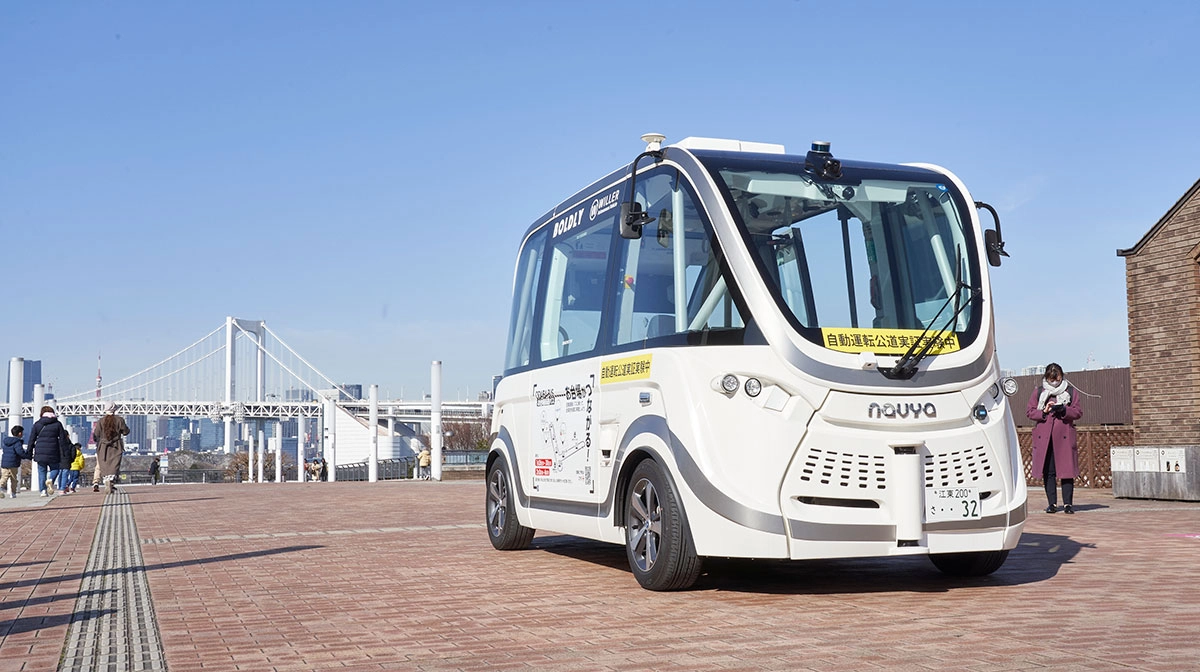
As an example of Tokyo, we are currently conducting demonstration experiments every year in the Nishi-Shinjuku area and the waterfront sub-center area. In the demonstration experiment conducted in January this year at the waterfront area, we were working on running a small self-driving bus in the park. Until last year, fences were installed in the park to prevent pedestrians and self-driving vehicles from crossing, and vehicles and pedestrians were separated. However, we were able to operate pedestrians and vehicles in the same environment without fence this year. In addition, we conducted a demonstration experiment of running a medium-sized self-driving bus on public roads this fiscal year. Even on this 2.5km route on public roads, safe operation was achieved at a speed of about 40km/h, which is comparable to the speed of ordinary vehicles.
Odaiba ARMA
Unagi
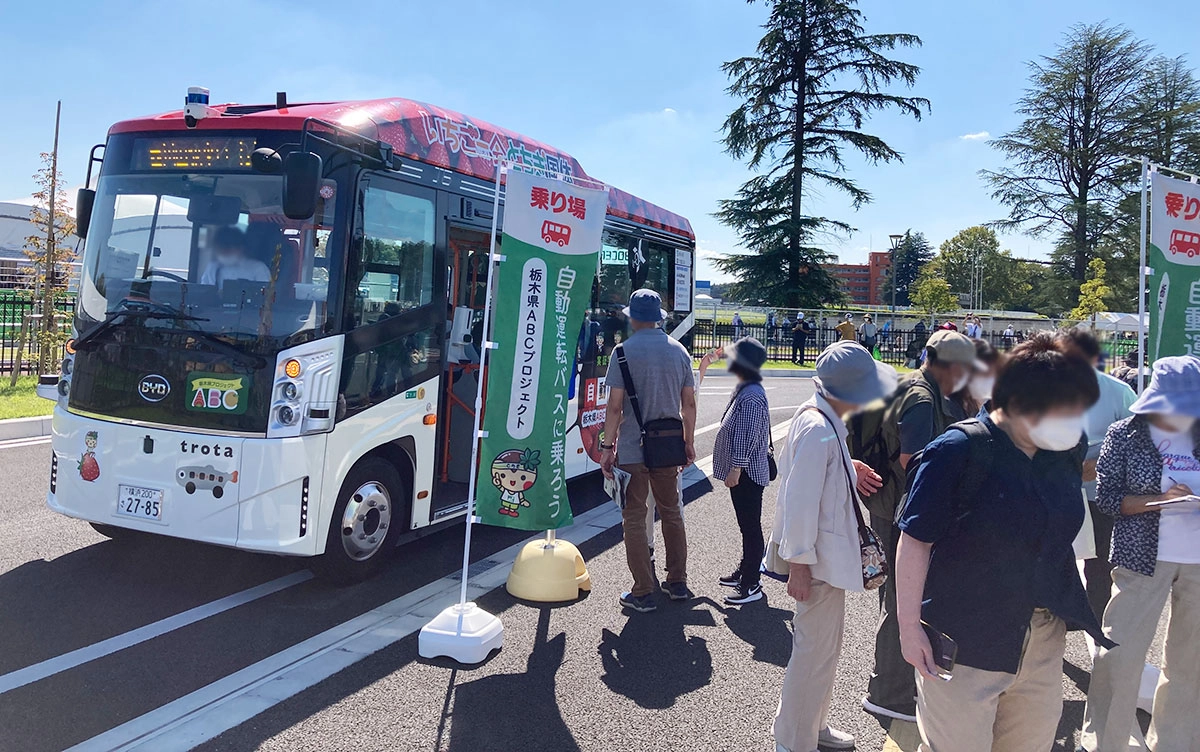
In Tochigi Prefecture, we are participating in a five-year project starting in 2020 that aims for social implementation. We set three types of locations: urban areas, tourist areas, and hilly and mountainous areas, and conducted demonstration experiments and verifications at a total of 10 locations. In particular, in the demonstration event in Utsunomiya held in conjunction with the "Ichigo Ichie Tochigi National Sports Festival" this year, a medium-sized automated bus was used to transport more than 3,200 visitors. There is a roundabout on the route connecting the nearest station and the venue, which is rare in Japan and traffic rules are not yet fully known, so it was a great opportunity to test safe operation. Also, on the day of the opening ceremony, there was a Blue Impulse air show, so there was a time when many people looked up at the sky and did not notice the traffic of the buses. Being able to operate safely in such a harsh environment has given me confidence.
Ride queue at the Utsunomiya demonstration test
Osara
Both regions have different characteristics, but what they have in common is that implementation is already imminent. As a future goal, the Tochigi Prefecture project aims to implement social implementation in as many locations as possible in fiscal 2025. In Tokyo, we would like to increase our collaboration with DIC (Digital Innovation City concept by the Tokyo Metropolitan Government that promotes "implementation of digital technology" and "accumulation of startups") and achieve further results.

Working on the implementation of automated mobility services with a sincere desire to "create a society where everyone has the freedom of mobility and can live a prosperous life in a Japanese way.”
With awareness and pride as a transportation professional, aiming to implement automated tran sportation services in society.

―Mr. Osara and his team, who have worked as a transportation planning specialist, are working on the social implementation of automated mobility services while making use of their experience. What are their struggles in making the technology commonplace, for which there are still few precedents in the world? Also, where is the motivation and driving force in working on implementation?

Tsuda
Demonstration tests of automated transportation services can only be carried out with the cooperation of various stakeholders, including prefectures, the police, and contract partner companies. Therefore, building strong relationships is essential. In addition, once the demonstration experiment begins, we need to spend a considerable number of days in the field, and we struggled to optimize the division of roles among members and how to share information on-site. However, the interesting thing about automated vehicles is that they offer opportunities that are more rewarding.
Tanaka(Atsushi)
For example, on a test drive day, you can directly hear the voices of , "Wow! “or “Automated car has come so far!”. Until now, I rarely met ordinary people in my work such as traffic congestion countermeasures, accident prevention, and logistics efficiency. Seeing their faces makes me want to protect their lives somehow. Of course, I have felt a great deal of satisfaction in conventional transportation planning but being able to see the faces of the citizens is an environment that makes my heart pounding as an engineer.
Yasuike
Automated mobility is a genre that has never existed before, so normally it would be hard to study. But I am highly motivated, and it doesn't bother me at all. We are improving the overall level while cooperation within the team, such as "A new technology was developed in that country," or "The new model has been released,"
Osara
Most of the other members, myself included, have experience in transportation planning. Some members participate in committees that decide national systems. Also, based on our past achievements, we have had many opportunities to be nominated and asked for our opinions, such as "What do Nippon Koei think about this case or concern?" All of us are self-aware and proud of being traffic professionals, and we aim to implement automated transportation services in society.

Automated mobility services are one form of social contribution. We aim to be a leader in this field because of the various ways it can be utilized.

―The goal is to implement automated mobility services in 50 locations in Japan by 2025, but it is predicted that after that, introductions will continue to occur throughout the country and become the norm. I asked Mr. Osara about the future of automated mobility services, including his team's thoughts, and how we at Nippon Koei are moving toward that future.

Osara
I feel that we are now about halfway there if one goal is to have automated mobility services become a standard in society above a certain level. It was not thought possible to achieve this so quickly a few years ago. However, once the goal was set in concrete, the sense of urgency increased, and everyone became serious, which accelerated the realization of the goal. This is only my opinion but considering the desire and the progress that has been made, I believe that some form of social implementation of automated mobility services will be realized by 2025.
Tanaka(Anna)
I believe that Japan’s automated mobility services are among the best in the world in terms of quality. It is true that in the U.S. and China, automated driving has already been implemented and is in the operation and utilization stage. However, Japan is not lagging behind. We are on the verge of implementing the Japanese rules, which are unparalleled in the world with their strict laws and systems.
Tanaka(Atsushi)
If we export our expertise in automated mobility services to Asian and African countries, we believe that we have an advantage because it will definitely be implemented in a hard environment. Also, Nippon Koei has a proven track record not only in technology, but also in the upstream process of creating systems in many parts of the world. We have the potential to become a partner in the implementation of automated driving on a national or metropolitan scale.
Tsuda
In fact, we are already participating in projects involving implementation in Asia and Africa in areas such as smart cities and MaaS. It will be possible to propose a large package that links such advanced technology and compatible automated driving system. The first goal is 2025. We will do our best to implement automated mobility services in society to protect people's wealth.
Osara and his team
We work as a team with members who have a variety of interest. We recognize that the automated driving service is a field where people with no roots in civil engineering can be active. We would like to work with other departments within the company. The more interested people join our team, the more projects we can be involved in. Please contact us if you are interested.

―Since its founding, Nippon Koei has pursued its fundamental goal of "enriching people's lives. At times, we thoroughly delved into conventional technologies, and at other times, we worked to master technologies that were just emerging in the world.  We have often discussed our vision of the future with national and local government officials, either as a consultant or as an engineer. Automated mobility services are the culmination of all the knowledge required in the history of transportation planning. We will continue to implement and develop the latest technology of automated driving service based on our policy of social contribution.


  1. HOME
  2. Performance
  3. Solving problems through automated mobility services will surely contribute to society.
to page top