
Work on the implementation of automated mobility services from the perspective of contributing to society by protecting people's lives.
Release:
Update:
NEW
CHALLENGE
We need to overcome the driver shortage and the collapse of the transportation infrastructure due to the declining birthrate and aging population.
Since 2020, various crises have hit the world, such as the spread of the COVID-19 infection and the deterioration of the situation in Ukraine and Russia. As countermeasures against these crises have progressed, issues that have traditionally been viewed as problematic have become even more serious. One such issue is the driver shortage, which is expected to continue to grow in 2023, with the effective ratio of job offers to applicants exceeding two times. According to the Ministry of Economy, Trade, and Industry (METI), there will be a shortage of 9.5% of transportation demand (540 million tons) by 2030.
In terms of declining birthrates and aging population, the aging rate as of 2023 is 28.4% according to data from the Cabinet Office. By about 40 years from now, the population aged 65 and over is expected to remain almost flat, while the population aged 20 to 64 is expected to decline significantly, and the aging rate is expected to increase by about 10%. In rural areas in particular, the population is returning their driver's licenses, and those areas that rely on private vehicles for transportation are facing a crisis in which mobility is becoming difficult.
One of the representative technologies to solve these issues is the automated mobility service.
SOLUTION
Case1:"Running in a space where pedestrians and vehicles coexist" and "Running on public roads at about 40 km/h" are realized in Tokyo.
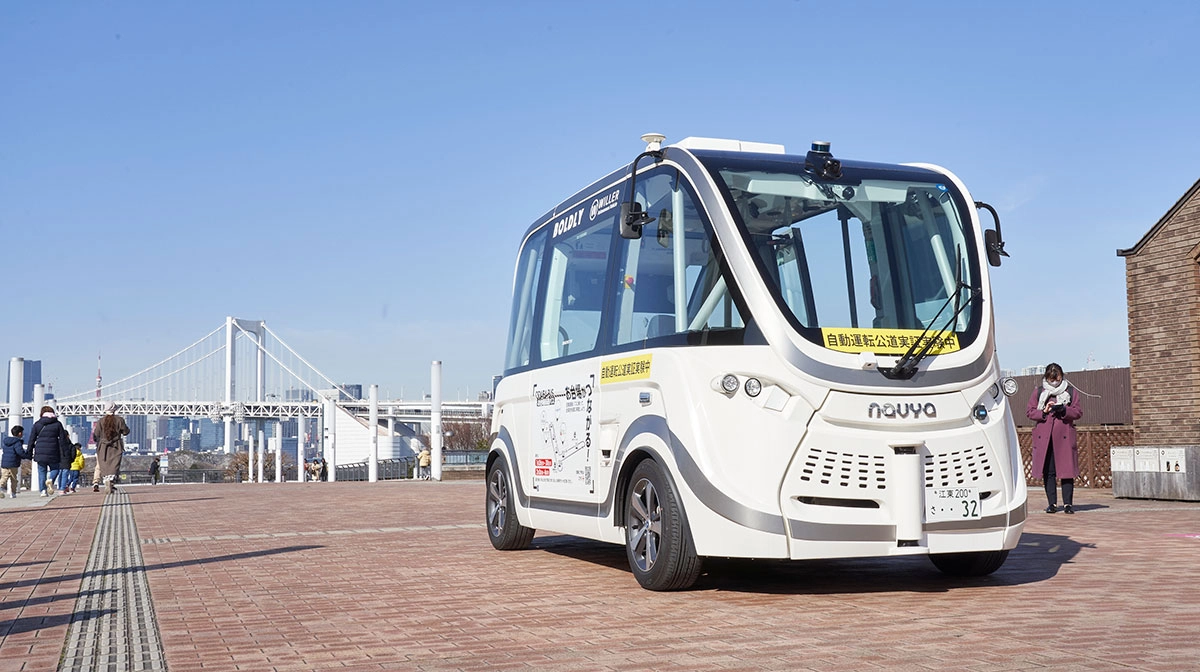
The Tokyo Metropolitan Government has been working toward the implementation of automated mobility services since 2018. Initially, plans were made to conduct demonstration tests in various locations in Tokyo, but in recent years, considering various conditions, the locations have been concentrated in Nishi-Shinjuku and the waterfront area. Each year, the demonstration tests have been conducted on a scale that has attracted media attention.
Nippon Koei is participating in this Tokyo Metropolitan Government initiative for automated mobility services as a project promoter. We aim to implement automated mobility service in society by fully utilizing our comprehensive knowledge and experience, including sounding and public solicitation of proposals from a wide range of private businesses on how to utilize automated mobility services on TMG-owned land, establishment and operation of a committee of experts to select outstanding projects, and contracting with selected project operators to conduct demonstration experiments.
he most recent demonstration experiment was conducted from late January to mid-February 2023 in the waterfront area of Koto-ku, Tokyo. This year, the Tokyo Metropolitan Government requested us to successfully operate the system in a pedestrian-vehicle coexistence environment, which had been realized in the park in 2021. Until now, the route had been separated by fences to prevent pedestrians from crossing the route and ensure safety, but in 2022, the fences were eliminated, and the automated buses were successfully operated in an environment where pedestrians could pass freely. The public trial ride was a great success, with comments such as, "It was amazingly smooth! and "I could feel the high level of safety.” In addition, the automated buses were able to operate on public roads at speeds of around 40 km/h after obtaining permission from the Metropolitan Police Department and all other relevant agencies. The project has been widely covered by the media and has received high acclaim from all quarters.
In 2023, in addition to further resolving safety and technical issues, we will expand the operation route and verify business feasibility and social demand, aiming for social implementation by the end of FY2025.
Case2:Conducted demonstration experiments one after another in Tochigi Prefecture with an eye on immediate social implementation.
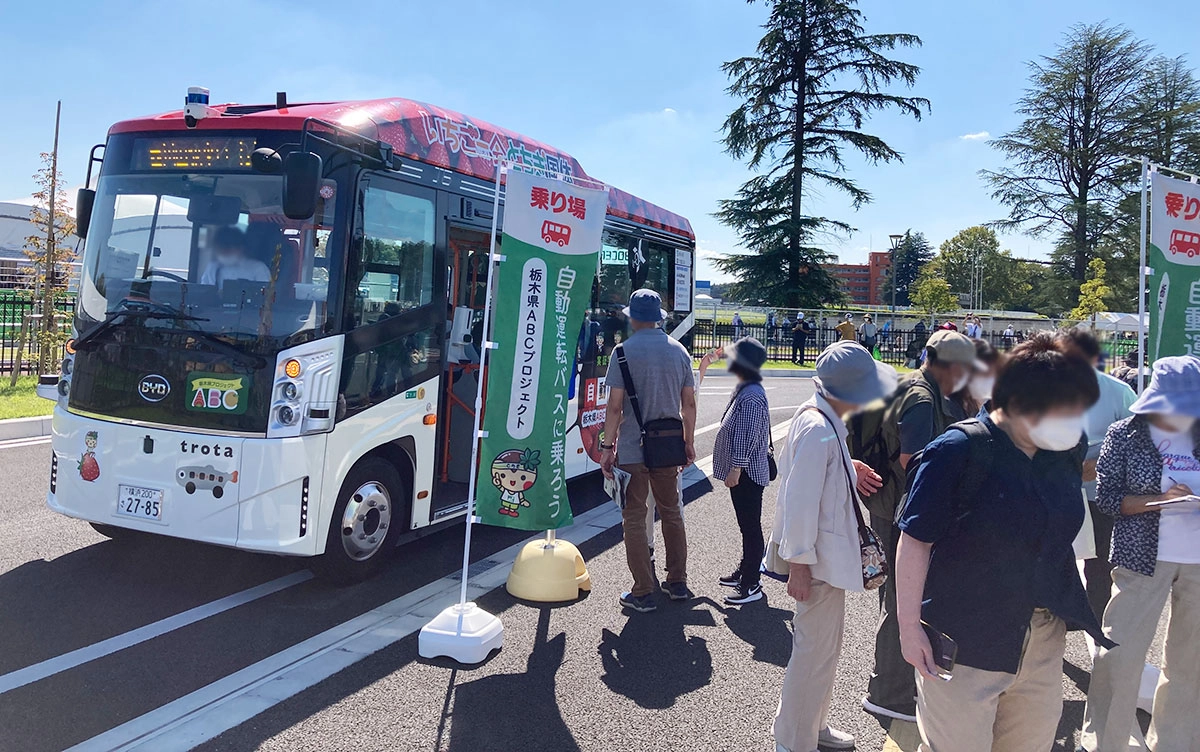
In Tochigi Prefecture, where the birthrate is declining and the population is aging, we are aiming to implement automated driving as one of the technologies necessary to maintain their lives. Tochigi Prefecture is characterized by a decrease in the number of drivers and the return of licenses even within the Tokyo metropolitan area. For this reason, many residents of the prefecture are starting to recognize that automated driving in public transportation is an essential technology for creating a society where people can live with peace of mind in the future. Tochigi Prefecture formulated a plan to conduct demonstration experiments in 10 locations within the prefecture in 2020. We continue to conduct experiments using automated vehicles suitable for each location in urban areas, tourist areas, and hilly and mountainous areas.
One of the achievements in FY2022 was the implementation of an automated driving demonstration experiment on the route connecting the stadium and the nearest station for the "Ichigo Ichie Tochigi National Athletic Meet". More than 3,200 people rode on an automated bus during the event. The same type of vehicle was used as in Tokyo's waterfront area and operated at a speed of about 40 km/h. In the past, we had also conducted demonstration tests in the vicinity of Oyama Station, where there is a Shinkansen station, and acquired various types of data, including not only verification of safety during operation, but also data on areas where automated operation was not possible and the bus was switched to manual operation, and the appropriate price of fares as perceived by general passengers. By organizing this information from comprehensive knowledge and identifying issues, we will further accelerate the move toward implementation.
FY2023 is an important year for automated driving system toward social implementation by FY2025. We will first determine the route we aim to realize, and then make proposals that includes Nippon Koei's unique perspective, as well as proceed with more specific demonstration experiments.
POINT
We face a national crisis as a company that knows the big difference between "realization of automated driving" and "implementation of automated driving."
Automated driving system is equipped with a variety of latest technologies and is considered a dream machine. The country and many prefectures are aiming to implement it by 2025, and it is just around the corner. What is required now is not only the development of safe driving technology, but also the establishment of an operation system, the formulation of operation plans, and monetization of the service, all from the perspective of maintaining the route in a sustainable manner while complying with Japanese law.
Nippon Koei has been working to solve transportation and urban issues not only in Japan but also on a global scale by formulating plans for public transportation operations, countermeasures against traffic congestion and accidents, and improving logistics efficiency, etc., mainly in transportation and urban areas. In addition, we have expanded our activities to planning and implementation of smart cities and MaaS, which are highly compatible with automated driving. We combine automated mobility services and the systems necessary for their development on our own.
We believe that the starting point of automated driving transportation services is to contribute to the prosperity and happiness of people through the optimization of public transportation. For many people, travel is not a primary demand for its own purpose, but a derivative demand that accompanies other purposes, and they would like to spend less time traveling and more time on their original objectives if possible. While always thinking about what it means to improve the quality of life, we will continue to aim to implement automated transportation services with a focus on social contribution.