
Expanding the Potential of "People" with Smart Cities: Nippon Koei Initiatives in Asia and Africa
Release:
Update:
NEW

CHALLENGE
Promoting smart city initiatives that build the future while solving the problems and meeting the needs of each country and city
When you hear the term "smart city", you may think of a town where advanced and revolutionary technology is used. It is true that cutting-edge technology has the potential to even transform the daily lives of humankind, but we at Nippon Koei are implementing smart city initiatives that continue to update our daily lives while keeping a close eye on new technology trends.
The reason is that we have been working as an infrastructure specialist. In the field of infrastructure, which is indispensable for a wide variety of cities, such as transportation, water supply, electric power, and disaster prevention, we have always promoted urban development that solves social issues and meets the needs of the country and the city. From our experience, even if evolution occurs through the internet of things (IoT), information and communications technology (ICT), digital transformation (DX), etc., these technologies will not change the entire city at once, but will evolve in each field of infrastructure. New technologies have a huge impact when they are introduced and attract a lot of attention, but periodic maintenance and upgrades must be carried out patiently and persistently. New technologies quickly become the norm and become commonplace.
Since time immemorial, people have pursued comfort and happiness. This is a universal goal of humankind that remains unchanged today. Nippon Koei is involved in the smart city initiative because our mission is to approach the formation of sustainable cities through the infrastructure necessary for cities to function and for people to be happy and comfortable.
SOLUTION
Promoting tailor-made smart city initiatives in Southeast Asia, South Asia, Africa, and other countries
Nippon Koei is expanding its business in overseas infrastructure and smart city projects, particularly in ASEAN countries, South Asia, and Africa. Social challenges in these regions are in the areas of transportation, tourism, and environment. For example, logistics and human flow can be further optimized through the provision and utilization of traffic information through traffic congestion mitigation measures and applications planned using big data. Contributions to the environmental field, such as reduction of exhaust gas emissions, can also be linked. As an example, the case study of Siem Reap City in the Kingdom of Cambodia will be explained.
Currently, two major projects are underway in Siem Reap City. One is being implemented by the Japan International Cooperation Agency (JICA), which has created a roadmap for the realization of a smart city with the Siem Reap Provincial Government from 2020 to 2022. For the subsequent three years from 2022, JICA is implementing a technical cooperation project aimed at capacity building to materialize the projects outlined in the roadmap. The second is the "Smart JAMP" project by the Ministry of Land, Infrastructure, Transport and Tourism (MLIT) to support smart city through Japan-ASEAN mutual cooperation, which aims to enhance tourism contents and disseminate digital tourism information using augmented reality (AR) and other technologies.
Since Siem Reap City is home to the World Heritage Site of Angkor, our first goal is to revive and evolve the tourism sector. Tourism and transportation have a very high affinity, and a variety of added value can be created from easing traffic congestion and utilizing traffic information. For example, dozens of waste collection trucks running in the city are hurrying to establish technology to efficiently move around and collect waste while keeping an eye on the capacity of waste bins at various locations, including hotels and restaurants. If the waste haulers also know in real time how the waste collection vehicles are moving, they can dispose waste more efficiently, thereby contributing to the beautification and sanitation of the surrounding area and improving the satisfaction of tourists. By collecting and analyzing data on the movement of vehicles in the city, it may be possible to realize effective waste collection and, beyond that, to widen roads and improve the conditions of intersections to realize stress-free travel and reduce economic losses due to traffic congestion.
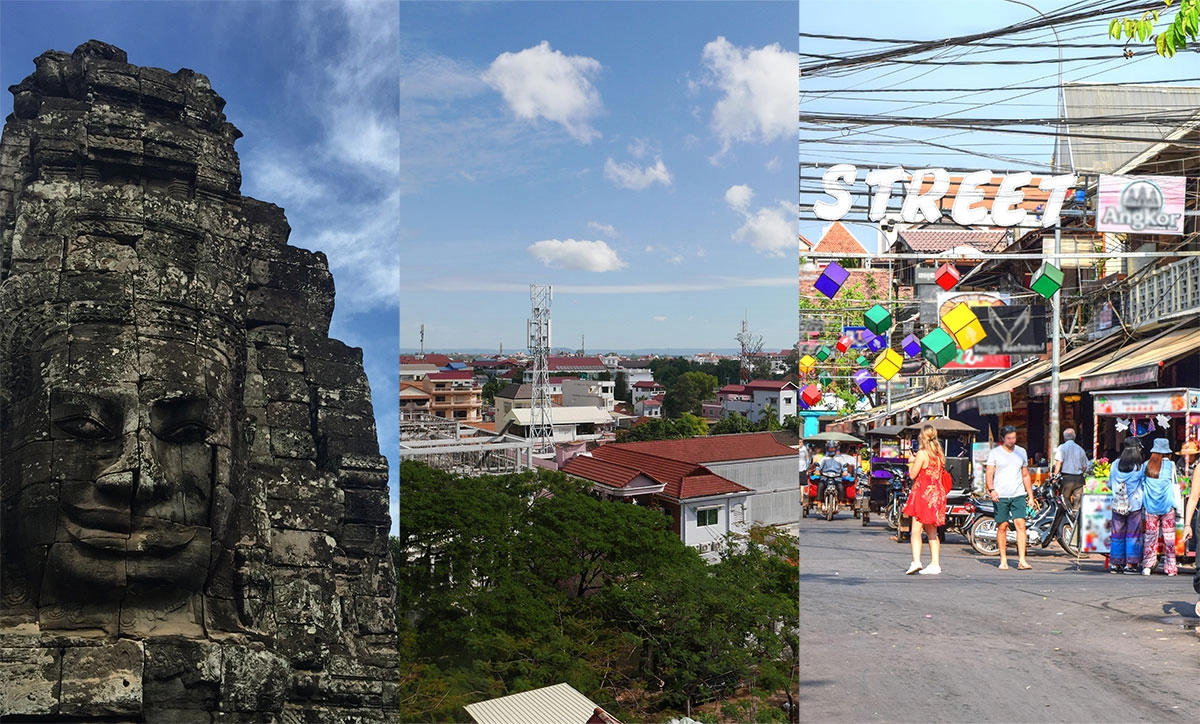
Siem Reap City is a relatively small city with a population of less than 300,000, so it is not a megacity with a population of 10 million where urban challenges are serious and immediate improvements are difficult. However, it is a city that relies on tourism and is certain to see population growth in the future. Various demonstrations can be effectively conducted before major problems arise, and the success of these demonstrations will be an important outcome that can appeal to future and potential tourists and tourism needs around the world.
POINT
Engage in smart city initiatives from the upstream process and continue to provide sustainability with local people at the center
Other representative examples include demonstration tests of automated driving and smart infrastructure management in industrial parks and other locations in Vietnam, and the creation of plans to realize various types of smart infrastructure in Vientiane, the capital of Laos, and Battambang in Cambodia.
Created based on an image from MLIT website, "Promoting Japan's MaaS"
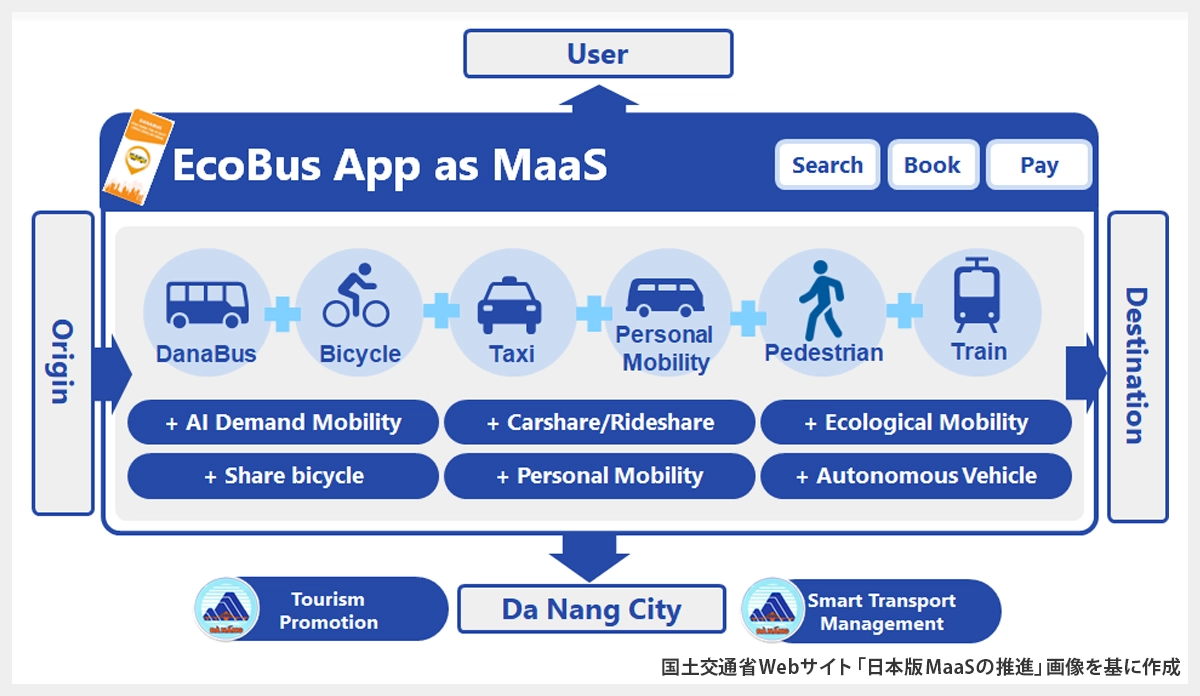
One of the reasons why we are able to move projects forward strongly in these regions is that there is less friction between existing institutions, procedures, and infrastructure and smart technologies than in developed countries. For example, in cities in developed countries, whenever a new technology is created, it is always in competition with the same type of technology, and there is also the problem of conflicts with laws based on older technology. It is not always easy to conduct demonstration tests or introduce new technologies. However, this is less likely to happen in emerging countries, where the leapfrog phenomenon is occurring, accelerating the speed of development. It can be said that the conditions are ripe for the deployment of smart technologies in cities.
As with the infrastructure development projects we have undertaken in other countries, Nippon Koei also places emphasis on the upstream planning stage in smart city-related projects. What is important in this process is not only technical capabilities, but also people-to-people relationships. In the past, we have worked to solve problems together with decision makers and officials in government and other organizations by meeting them face-to-face and discussing the future. We will continue to make proposals that put sustainability first while nurturing relationships with people.
In our smart city initiatives, sustainability is also a top priority for us. Among these, we consider the potential of "people" to be particularly important. Specifically, we do not miss making proposals for human resource development and capacity building because without human resources with knowledge of the technologies used, we will forever have to update our smart city with the support of other countries.

Nippon Koei wants to improve cities where people live and work together with local human resources to update them. Smart technology is one of the revolutionary means to achieve this goal. We will continue to pursue human happiness and comfort through consulting that looks far into the future.