
"KIBOH 2030™" Diagnostic System Visualizes Sustainable Development Goals (SDGs) Initiatives and Business Opportunities for Small- and Medium-sized Enterprises (SMEs) Promote businesses that enhance corporate sustainability and contribute to the SDGs
Release:
Update:
NEW
NEEDS
The key factors to Japan's ups and downs are small- and medium-sized enterprises (SMEs), which account for 99.7% of total companies in the country.
The United Nations has declared that it will achieve the 17 Sustainable Development Goals (SDGs) in 2030, and each country is aiming to realize these global goals. Even in Japan, understanding of the SDGs has advanced significantly, and the number of companies that take action for SDGs has begun to increase. However, most of the movements are being made by large companies that have the corporate strength to take action. From the perspective of instilling awareness and behavior in SMEs, the reality is that only a limited number of SMEs are involved and there is still a long way to go.
Data on the number of companies shows that the ratio of SMEs in Japan is 99.7%. About 32 million people are employed by SMEs, which is about 70% of Japan's working population.
It means SMEs action is essential in achieving the SDGs. (*1)
In fact, when we talked with SME managers, we found their concerns, typical examples of which include: what are the SDGs, what can be done to achieve them, what are the company's strengths in the SDGs, and lack of financial and labor resources to achieve them.
In order to solve these issues, Nippon Koei has launched a beta version of "KIBOH 2030™" as a tool to improve the sustainability of SMEs that support the region to create various businesses originating from SDGs, and to meet the needs of local SDGs / Environmental, Social, and Governance (ESG) investment and financing. We will contribute to the future of Japan and the world by using a diagnostic system that visualizes the efforts and business opportunities of SMEs in the SDGs.
SOLUTION
Visualize your company's efforts and management policies on the SDGs in just 30 minutes
It is becoming more common to see SMEs disseminating their SDG initiatives. However, many of them are concerned on how their current corporate activities are linked to the 17 goals. Our primary focus in developing “KIBOH 2030™” is to help each company confidently accelerate its business in terms of the SDGs. Specifically, what contributes to the SDGs in the context of their current corporate activities, what are the challenges, and what further efforts should be made to achieve the SDGs and link to ESG management. By visualizing the "past" and "future" of a company, we aim to provide the compass for management.
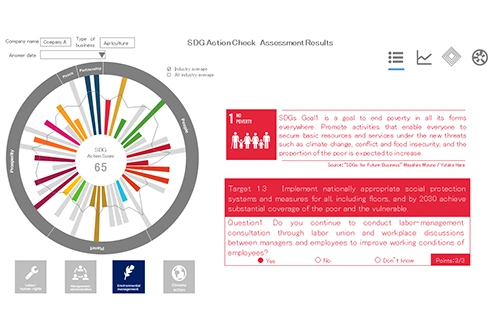
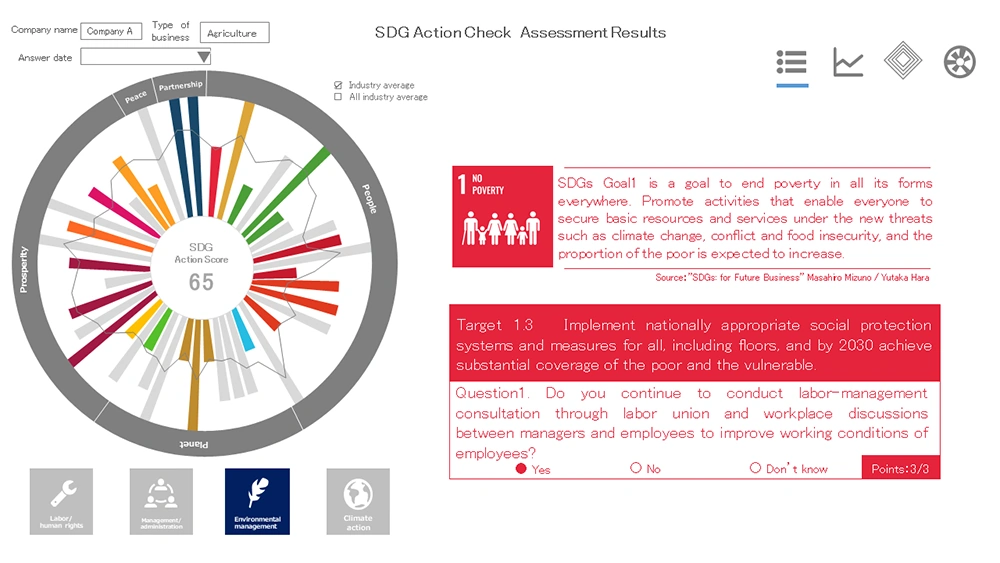
The SDGs include 17 goals and 169 targets, and the issues and their evaluation methods are also subdivided. “KIBOH 2030™”is a digital platform that provides an easy-to-understand, cost-effective overview of a company's environmental, social, and governance initiatives, grouped into four categories, namely; "Business Management," "Environmental Management," "Labor Human Rights," and "Climate Behavior". The questions have been narrowed down to 50 and can be answered with four choices. It will only take about 30 minutes to answer the questions, and once all questions are answered, the evaluation of initiatives is "Visualized" in terms of scores (Scoring) and achievement rates (Graphs).
In the beginning for “KIBOH 2030™”, it was assumed that ID and password would be distributed to the users and operated by themselves. However, through demonstration of the Beta Version, it was found that interactive method would be effective for owners of the companies to organize their ideas and grasp the trends of each company. Currently, it is operating through the interactive method to answer the questions.
POINT
Nippon Koei's Sustainability Consulting Accelerates Further
Toho Bank (Fukushima Prefecture), Sapporo City, and the Sapporo Chamber of Commerce and Industry also participated in the demonstration of Beta Version. As of December 2021, all verification works have been completed and the official version has been released.
Through the interactive or face-to-face method of demonstration, it was reaffirmed that SME owners, local governments, and local financial institutions have a common mission to take some actions on the SDGs. The size of the company does not matter to this concept. Companies with only few employees were interviewed and yet strong responses have been received such as "if we can contribute to the world, we would definitely like to do so. "In general, there is a growing need for companies to "Learn about their own corporate activities from a bird's eye view", "Learn how the value of their business can benefit society", "If there are advantages that can bring them closer to achieving the goals of the SDGs, they want to develop them", and (for slightly larger companies) "Want to shift to ESG management. "
If the significance of a company's existence is defined as "Responding to the demands of society", society is now beginning to demand for the realization of a sustainable future. We can enhance sustainability of the companies through inventory of their business and history, and organizing what meets the needs of society, what can be accelerated using their strengths, and what needs improvement.
Nippon Koei is a sustainability consultant firm with technologies and expertise that can provide proper advice for implementation. We declare that we will work together to create a bright future through our sustainability consulting services for companies, society, and communities.
Reference
- ※1The Economic Census of 2016